ESSAY 01 / SPACE
There Are Absolutely No Aliens
It wasn't that there were stars in the sky. There were so many stars that the darkness was what lay in between. A change in how I see the universe, beginning on Yakushima when I was eleven.

The first time I felt the universe was one night when I was eleven.
I was on a trip to Yakushima with my father and younger brother. After dinner, my father took us to an open space by the sea. I still remember the sky we looked up at there.
It wasn't that there were stars in the sky. There were so many stars that the darkness was what lay in between.
The mountain ridges cut black shapes out of that sky. A sky filled with stars, and mountains without a single light. Decades later, I can still picture the line between them.
—With this many stars, there has to be someone out there.
As a child, I felt certain of it. Even as an adult, I never had much reason to doubt it.
A long time has passed since then. And now, for the title of the first essay in this series, I've written this:
There are absolutely no aliens.
Those are strong words. I don't mean that science has proved their absence. But I once took it for granted that they existed, and now I look at the universe from the other side: perhaps they don't. I chose that word deliberately, to express the size of that change.
The turning point was a paper I read in 2020.
Today, I want to write about why, and what changed for me afterward. Let me start with what I used to believe: of course they're out there.
The sky was supposed to be full
Let's put some numbers on the page.
Our Milky Way is estimated to contain roughly 100 billion to 400 billion stars, including stars like the Sun. Around them are many more planets. And this galaxy is itself just one of countless galaxies in the universe. NASA's explanation
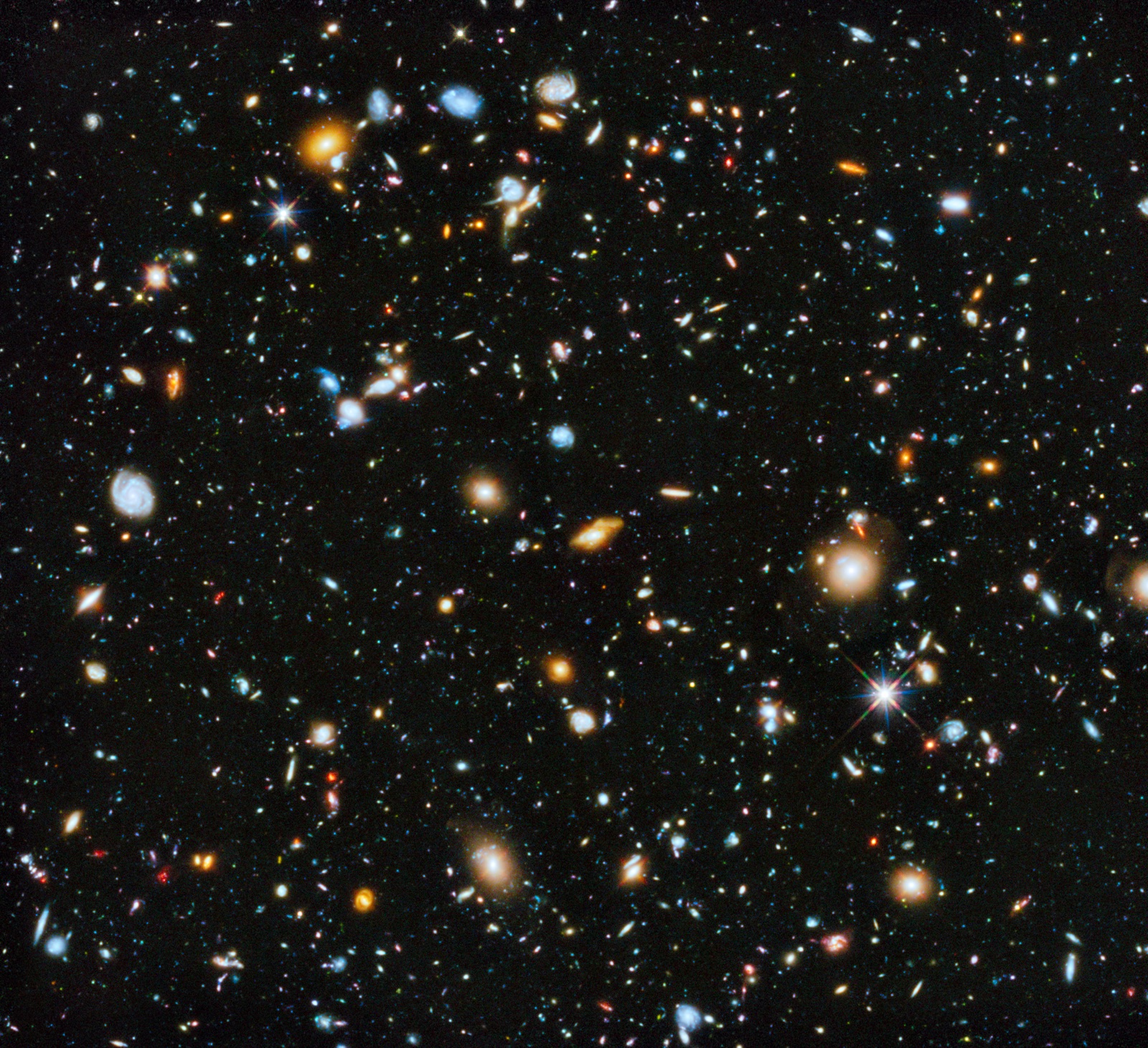
HUBBLE ULTRA DEEP FIELD / 2014
Around 10,000 galaxies in this tiny patch of sky.
A composite of ultraviolet, visible, and near-infrared observations made between 2002 and 2012 in the constellation Fornax. Those points of light are not all stars. Many are galaxies, each holding countless stars.
Credit: NASA, ESA, H. Teplitz and M. Rafelski (IPAC/Caltech), A. Koekemoer (STScI), R. Windhorst (Arizona State University), and Z. Levay (STScI)
NASA / ESA/Hubble · CC BY 4.0 · Resized and compressed
It seems less natural to think that Earth alone is special.
However unlikely the emergence of life might be, with this many opportunities, surely it must happen somewhere. It actually happened on Earth. It must have happened elsewhere, too.
The astronomer Frank Drake, a pioneer in the search for extraterrestrial intelligence, devised the Drake equation to estimate the number of detectable civilizations in the Milky Way. Under a particular set of assumptions, Drake himself estimated that number at around 10,000. The SETI Institute's explanation
Ten thousand civilizations in the same galaxy.
That number sat comfortably with the intuition of the boy who had looked up at the stars that night. To me, the existence of aliens was almost common sense.
The sky was supposed to be full.
“Where is everybody?”
There is a question famously associated with the physicist Enrico Fermi.
“Where is everybody?”
—Where is everyone?
If intelligent civilizations are common, and some survive long enough to reach other stars, you would expect to find traces of them somewhere.
And yet the sky is quiet.
At least, our searches so far have not confirmed the existence of extraterrestrial life or civilizations. If there are supposed to be so many, why haven't we found any? This gap is known as the Fermi paradox. NASA: The search for life
Are they too far away? Do civilizations fail to last? Or are we looking in the wrong way?
There are many possible explanations. I'll leave those for the next essay. But the question that stopped me came a little earlier.
Are there really so many in the first place?
A probability smaller than the stars can make up for
“Emergence of life in an inflationary universe,” published in 2020 by Professor Tomonori Totani of the University of Tokyo. This was the paper that changed how I saw things.
Just how unlikely is the emergence of life?
“Very unlikely” is not an answer. Let's put some numbers on the page again.
The paper examined a process in which the building blocks of RNA join together at random, forming a molecule with a function that could lead to self-replication—a progenitor of life. Remarkably, under its basic setup, with a required RNA length of 40 nucleotides, you would need roughly 10³⁹ stars to expect life to emerge once. The number of stars the paper assigns to the observable universe, meanwhile, is roughly 10²². Totani's paper, Figure 1 and accompanying text
Thirty-nine and twenty-two. Written down like that, they may not look so far apart. But these are not counts. These are powers of ten.
The gap is a factor of 10¹⁷. One hundred quadrillion.
Expressed per star, that gives a rough chance of life emerging of one in 10³⁹. This is not the probability of a single collision between molecules. It is a calculation within that model, including repeated chemical reactions over roughly 500 million years.
Even multiplying that chance by 10²² stars gives an expected number of origins of life of about one divided by 10¹⁷. Far, far short of even 0.00001 occurrences.
Countless stars.
A different probability, a different picture.
With 1022 stars, the expected number of origins is 10-17. Less than one.
The number of stars is enormous. Even so, the improbability can be greater by many orders of magnitude.
This was where I finally stopped. I realized that, overwhelmed by the number of stars, I had merely assumed I understood the other number.
Let me add something here. These figures are not measurements of the probability that life will emerge. They come from one model, with assumptions about the length of RNA and how it forms. If more efficient mechanisms for making RNA are at work, the estimate changes. The paper does not rule out the possibility that life emerges frequently. The paper's conclusion
Even so, it is a hypothesis well worth considering as one model. And if the calculation is right, why is there life on Earth?
Professor Totani connected the origin of life with the size of the whole universe. If inflation—the rapid expansion of the early universe—made the universe as a whole far larger than the region we can observe, then even an extraordinarily rare origin of life could occur somewhere within that whole.
A short detour: What is the observable universe?
And we can ask this question precisely because we are in a place where life emerged. This is an idea known as the anthropic principle. But the single example of life on Earth cannot tell us that life emerges easily elsewhere.
“The universe is so vast. There must be life elsewhere.”
For the first time, a crack appeared in a sentence I had found reassuring for so long. In another essay, I want to take a closer look at Totani's calculation, and at which assumptions shape its results.
Why I chose the word “absolutely”
Let me return to those strong words at the beginning.
Nothing we have discussed proves that there are “absolutely no aliens.” Restricting the claim to the observable universe does not change that.
And the existence of very simple life, the existence of intelligence capable of building a civilization, and the ability to communicate with us are all separate questions.
Even so, I now stand on the side that thinks they are not there. I take seriously the possibility that, within the observable universe, Earth is home not only to the sole intelligent life, but to the sole life of even the simplest kind.
I went so far as to write “absolutely” because the change in my perspective was that great. And there is a question I want that word to force me to face.
If we are alone, how should we treat this civilization?
For a moment, remove the assumption that someone else is out there. Remove it completely. When I do, not only the stars but we ourselves, living here on Earth, begin to look different.
If no one else is there, what of that night's sky?
From here on, these are my own thoughts after reading the papers, not their conclusions.
What if the intelligence born on Earth is rarer than we imagine?
What if, within the region we can observe, Earth is the only place with beings who ask how the universe came to be, and find beauty in its light?
And what if, after this civilization is lost, there is no one else to inherit those questions?
To me, that feels terribly fragile. And frightening.
Finding the stars beautiful. Wanting to know where their light came from. Talking with someone about the strangeness of being here at all.
Things we hardly think of as special may be extraordinarily rare in the universe. We are part of the universe, looking at the universe, trying to understand what it is.
Seen that way, carrying intelligence and consciousness into the future feels to me almost like our reason for being as inhabitants of Earth—a reason that comes with responsibility.
Since I began asking this question, the way I look at technology and business has changed, too.
Take Elon Musk. In an interview published in 2014, he spoke of our duty to protect the light of consciousness and carry it into the future. He also explained the expansion of life to multiple planets as a way to prepare for events that could make humanity extinct. The interview
Through his businesses, he works on improving Earth's environmental sustainability (Tesla), space exploration and the rise of electronic intelligence (SpaceX and SpaceXAI), and the merging of the human brain with AI (Neuralink). To me, he too seems to see Earth, which has nurtured life and consciousness, as an extraordinarily rare planet in the universe—and to approach these businesses with a sense of mission because of that view. I suspect he isn't selling cars just to address climate change.
Intelligence born on Earth surviving, carrying its questions farther and farther. When I begin to see his businesses this way, I sense his own distinctive self-awareness and other-awareness, extending beyond the bounds of Earth and out into the universe. Who are we, as a species, in this universe? And what can we leave for all that exists beyond ourselves? Of course, this cannot explain everything he does, but it is one reason I find him compelling.
And when I think about a future in which humanity and electronic intelligence live together, another question remains.
What will we carry forward?
Whether AI's abilities grow and whether it has consciousness or sensibility are not the same question. Beyond knowledge and the power to calculate, what do we want to leave to the future?
In The Sense of Wonder, Rachel Carson wrote about the importance of being astonished and moved by the world's mysteries. The Sense of Wonder, Japanese edition
Stopping to look at a star-filled sky. Noticing the scent of the wind or the soil. Feeling that time spent with someone is irreplaceable. In other words, these are also ways of noticing that the world is already full of “universal beauty.”
A sense of wonder about the world, and a willingness to care for others. Perhaps these are things we feel precisely because we have bodies, have grown up in an analog world, and have lives that will end.
And what if these emotions, which reason alone cannot fully explain, were also part of the force that carried civilization far enough to create electronic intelligence?
I cannot help feeling that something here offers a clue to how we might live in the future. Even if that sounds like sentimental wishful thinking, with so much talk today of AI as a threat, I want to believe it all the more.
Are there aliens, or aren't there? We have come a long way from that question.
But I think it is all connected. Because the question of who we are leads to the questions of what we make, and what kind of future we want.
The sky I looked up at that night, with my father and my brother, is still with me.
As a child, I thought there had to be someone beyond it. Now I think about what it will take for there to keep being someone who looks up at that sky.
I began this series to walk that path, one step at a time.
Next time, I'll look more closely at the Fermi paradox. Then, through Totani's paper, the Great Filter, the Rare Earth hypothesis, and others, I want to examine, one by one, the possible reasons for the sky's silence that I have chosen to explore.
It will be a long journey. I'd be glad to have you along.